The Rule of St David
Four Books in One Volume
£10.00
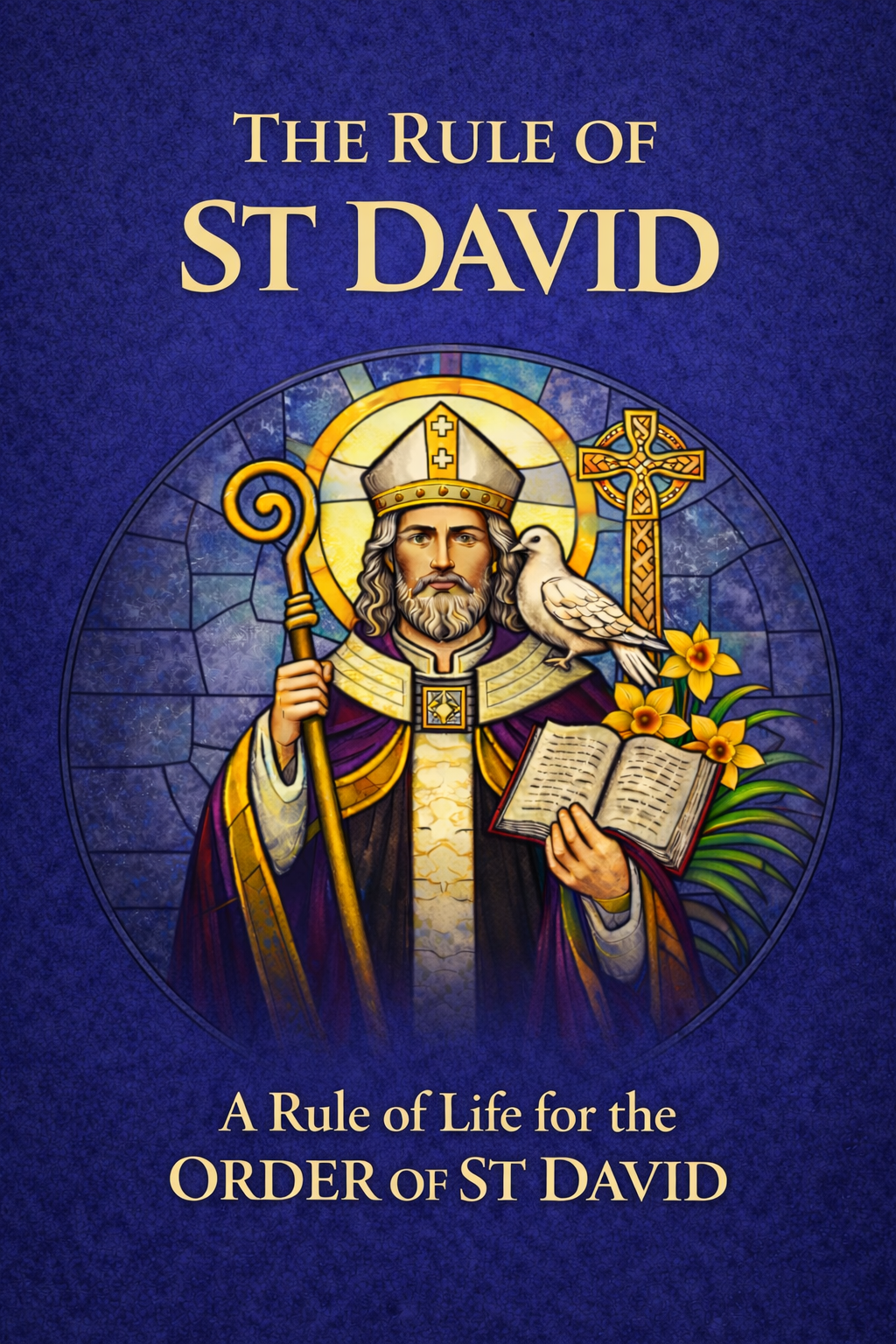
The Rule of St David: A Rule of Life for the Order of St David
Four books in one volume, for the members of the Order and all who seek God in the ordinary
Introductory Essays on St David's last words
The Rule of St David
Living the Rule of St David - the Companion (six parts of essays)
Retreat Guide - A Book of Celtic Prayers (the "retreat book" with its structure through the hours of the day and special occasions that serves as a retreat guide)
This volume brings together four complementary works, each complete in itself, each designed to be used alongside the others. Together they offer not merely a rule to be observed but a way of life to be inhabited: rooted in the Celtic and Benedictine traditions, shaped by the wisdom of St David of Wales, and addressed to those who seek God in the midst of ordinary secular life.
Book One: The Last Words of St David
On the morning of his death, sometime in the late sixth century, Dewi Sant gathered his community around him and spoke the words by which he is best remembered: Byddwch lawen. Cadwch y ffydd. Gwnewch y pethau bychain. Be joyful. Keep the faith. Do the little things. This opening section takes those seven words as its subject and explores them with the depth they deserve.
Three extended essays examine each phrase in turn. The first, Be Joyful, traces the quality of gladness that characterised the monastery at Menevia: not mere optimism, but the deep, Spirit-given joy of a community that knew itself to be exactly where God intended it to be. The second, Keep the Faith, examines what David meant by fidelity, the steady, unspectacular commitment to the Christian life that outlasts feeling and endures difficulty. The third, Do the Little Things, explores the most demanding of his instructions: the conviction that holiness is found not in great gestures but in the faithful performance of ordinary duties, offered with attention and love. A closing reflection, One Sentence, One Life, draws the three threads together and asks what it would mean to take these words as seriously as David himself took them. These essays set the spiritual tone for everything that follows.
Book Two: The Rule of St David
The Rule itself is the canonical heart of the volume. Promulgated by the authority of the Primate of the Ancient Apostolic Catholic Church, it provides the formal framework of life for the Order of St David: a secular institute whose members live their consecration not in a monastery but in the conditions of ordinary work, family, and civic life.
The Rule begins with a Prologue that situates the Order in the tradition of both St David and St Benedict, identifying the three pillars on which the Davidic life rests. It then moves through five structured parts: the identity and canonical status of the Order; the spiritual life, covering prayer, the Divine Office, lectio divina, the Eucharist, the three vows of rootedness, wholehearted devotion and faithful service, humility, good works, silence, obedience, ongoing conversion, the theological virtues, and asceticism adapted for modern life; the community life of a dispersed Order; the stages of formation and profession; and the final provisions governing the Rule's interpretation and amendment. An appendix provides a full formation curriculum and recommended reading arranged by stage. Throughout, the Rule is notable for its practicality: it does not merely prescribe obligations but provides worked forms, methods, and guidance to help members actually live what it requires.
Book Three: Living the Rule of St David
Where the Rule prescribes, the Companion explores. This substantial volume of theological essays and reflections is organised in six parts, each addressing a major dimension of the life the Rule calls its members to live.
Part One: Foundations examines the spirituality of St David himself, the Benedictine inheritance of prayer and work, the nature of the three vows in secular life, and the theology and practice of formation. Part Two: The Life of Prayer provides extensive practical guidance in Celtic and Benedictine prayer: how to pray the Liturgy of the Hours, how to read the Psalms as living prayer, the practice of lectio divina, mental prayer and contemplation, and the Daily Examen. Part Three: The Sacramental Life explores the Eucharist as source and summit, the theology of penance, and the place of Marian devotion in the Order's spiritual life. Part Four: Living in the World addresses silence and solitude in a noisy age, the practice of hospitality as encounter with Christ, and the reading of Scripture as an act of formation rather than information. Part Five: Community and Mission reflects on what genuine community means for a dispersed Order, the nature of apostolic vocation in secular life, and the indispensable role of spiritual direction. Part Six: The Celtic Inheritance draws together the distinctive threads of the tradition: the theology of creation as a second scripture, the practice of pilgrimage both literal and interior, and the ancient understanding of the thin places where heaven and earth draw close.
Each essay concludes with questions for personal reflection, spiritual direction, or community discussion. The Companion is designed to be read slowly, one chapter at a time, in the spirit of lectio divina rather than as a systematic text.
Book Four: The Little Hours: A Book of Celtic Prayers
The fourth book is a complete guide to prayer for retreat and daily life, structured around the canonical hours of the day and the three pillars of St David's dying words. Prayers are arranged in four daily sections, Morning, Midday, Evening, and Night, each organised under the headings Be Joyful, Keep the Faith, and Do the Little Things. Within this framework the book serves equally as a guide for a single day of quiet recollection and for a three-day silent retreat, with each day's arc of prayer providing a complete movement from rising to rest.
The prayers are drawn from three sources: traditional prayers from the Carmina Gadelica, Alexander Carmichael's great collection of Gaelic devotion; prayers from the ancient Celtic Church composed by the saints of Wales, Ireland, and Scotland; and prayers newly composed in the Celtic style for the conditions of modern life. A fifth section offers prayers for the seasons of the year, for times of difficulty including illness, grief, anxiety, and failure, and for the significant moments of human life from new beginnings to farewell. The book closes with a prayer to St David and a final meditation on the little things as the true material of the spiritual life.
Shalom
You're Welcome Here
Whether you are looking to learn, participate, or simply connect, Beit Or Hadar is open to you.
Contact Us
Address
Phone

Beit Or Hadar © 2025. All Rights Reserved.
Prior General
Most Rev Felix Gibbins OSD
prior@orderofstdavid.org
Subscribe to our newsletter
The Order of St David © 2026.
The Order of St David is a Secular Institute of Consecrated Life erected under the Canon Law of the Ancient Apostolic Catholic Church
Prayer to St David
O God, who did call your servant David to be a preacher of the Gospel and a light to the people of Celtic communities, grant that we who honour his memory may follow his example: being joyful in faith, steadfast in hope, and faithful in the little things of daily life. Through the intercession of St David, may we drink deeply from the well of your grace, labour faithfully in your vineyard, and at the last come to that blessed rest where, with him and all your saints, we shall praise you for ever. Through Jesus Christ our Lord, who lives and reigns with you in the unity of the Holy Spirit, one God, world without end. Amen.