
Frequently Asked Questions
What is a secular institute?
A secular institute is a form of consecrated life recognised by the Church in which members profess the evangelical counsels (the traditional commitments of religious life) whilst remaining fully engaged in the world. Unlike monks or nuns, members of a secular institute live in their own homes, pursue their own careers, and maintain their ordinary family and social responsibilities. Their consecration is real and complete, but it is lived out in the midst of everyday life rather than behind monastery walls.
This form of life has deep roots in Christian history, but was formally defined and recognised in the twentieth century. The Second Vatican Council affirmed that holiness is not the preserve of the cloister: every baptised person is called to the fullness of the Christian life. A secular institute is one way of responding to that call with particular seriousness and structure. Members are not failed monks or aspirational clergy. They are people who have discerned that the world itself is their monastery, and that the ordinary texture of daily life -- work, family, friendship, solitude -- is the very place in which their consecration is to be lived and witnessed.
Do I have to be a priest or religious to join?
Not at all. The Order of St David is open to lay people as well as clergy. In fact, the majority of secular institute members worldwide are lay people. Whether you are single, married, or ordained, there is a place for you within the Order if God is calling you to this way of life.
The Order deliberately holds together those in different states of life, because the Celtic tradition from which it draws its inspiration understood the whole community of the baptised as participants in a shared pilgrimage. Lay members, clergy, and those in other forms of ministry each bring something distinctive to the life of the Order. No one state of life is considered superior to another. What matters is not the external shape of your life but the sincerity of your desire to seek God and serve others.
I am married. Can I still join?
Yes. Married members are welcomed and valued. Your spouse will need to give written consent, which indicates their understanding of the Order's nature and their willingness to support your vocation. Married members live out the evangelical counsels in a manner appropriate to their state: chastity is expressed through faithful, loving commitment to your spouse; poverty through simplicity and generosity; obedience through humility and service.
Marriage is not an obstacle to consecrated life in a secular institute -- it is itself a vocation, and one that the Order honours. The consent of your spouse is requested not as a formality but because the Order wishes to be honest with the families of its members. Formation and prayer commitments will touch the rhythms of home life, and it is important that those closest to you understand and support what you are undertaking. Many members find that their consecration deepens rather than disrupts their marriage, bringing a greater intentionality and prayerfulness to the love they share.
How much time does membership require?
The Order asks for a commitment of at least one hour of prayer daily (which may be divided across the day), regular participation in gatherings (ordinarily monthly at regional level and annually at the general level), meetings with your spiritual director (at least monthly), and an annual retreat of at least three days. The specific shape of your commitment will be tailored to your circumstances in consultation with your spiritual director.
This may sound substantial, and it is a genuine commitment. But it is worth noting that the daily hour of prayer need not be a single unbroken block: many members find that praying the Little Hours across the day -- a few minutes at morning, noon, and evening -- fits naturally into working life, drawing ordinary moments into a pattern of recollection rather than requiring large portions of time to be set aside. The Rule of St David is not designed to add burdens to already busy lives. It is designed to help you discover, gradually and gently, that the life you are already living can become a form of prayer.
Is the Order part of a Church?
The Order is established within the Ancient Apostolic Catholic Church, an independent Catholic jurisdiction that maintains the fullness of Catholic faith, sacraments, and apostolic succession. It is not under the jurisdiction of Roman, though it shares the same theological and sacramental heritage. Members of any Catholic jurisdiction who are in good standing may enquire about membership.
The Ancient Apostolic Catholic Church stands in the ancient stream of apostolic Christianity, and its bishops hold valid orders in the apostolic succession. It upholds the seven sacraments, the creeds, the doctrines of the undivided Church, and the spiritual tradition of the Western Catholic Church. Members of the Order therefore find themselves in a jurisdiction that is fully Catholic in faith and sacramental life, whilst operating with the pastoral flexibility and accessibility that characterises independent Catholic communities. If you have questions about how this relates to your own church background, we are very happy to talk these through with you.
Do members wear a habit?
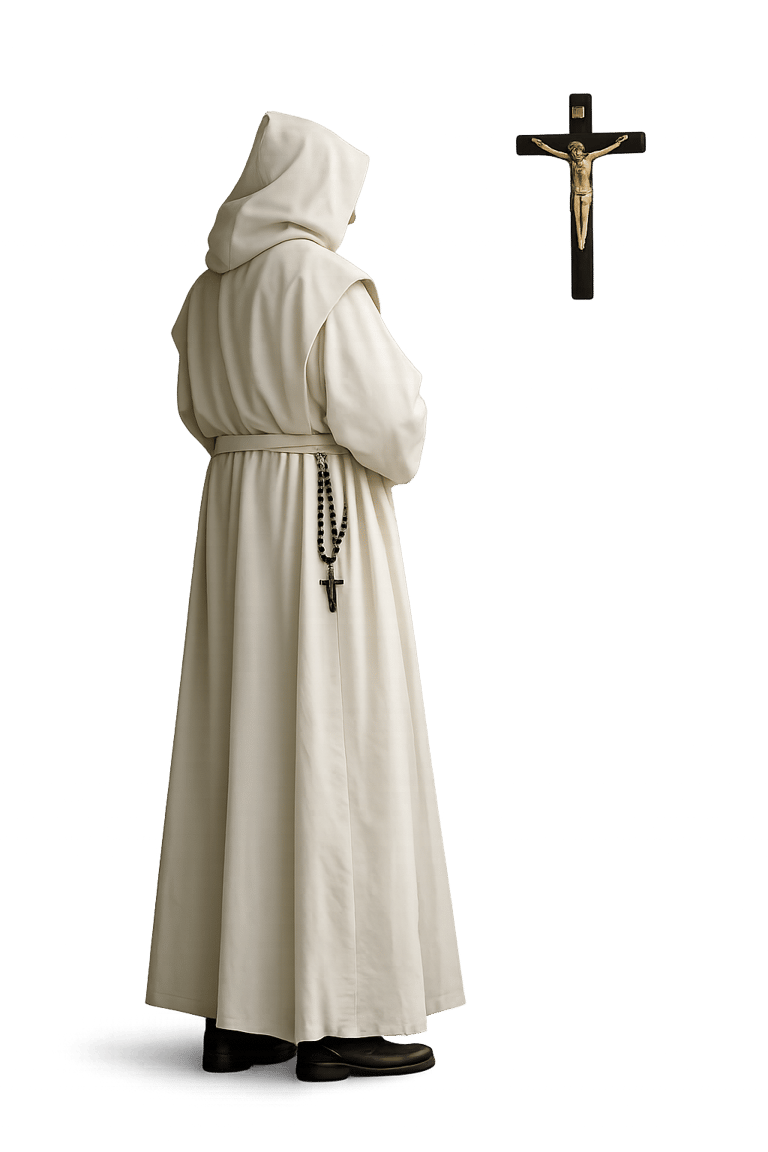
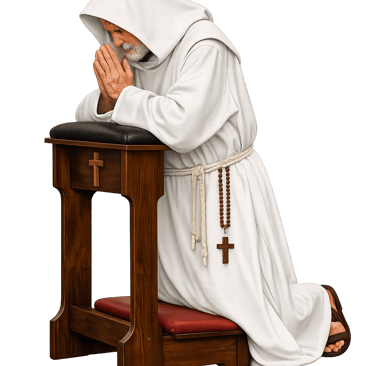
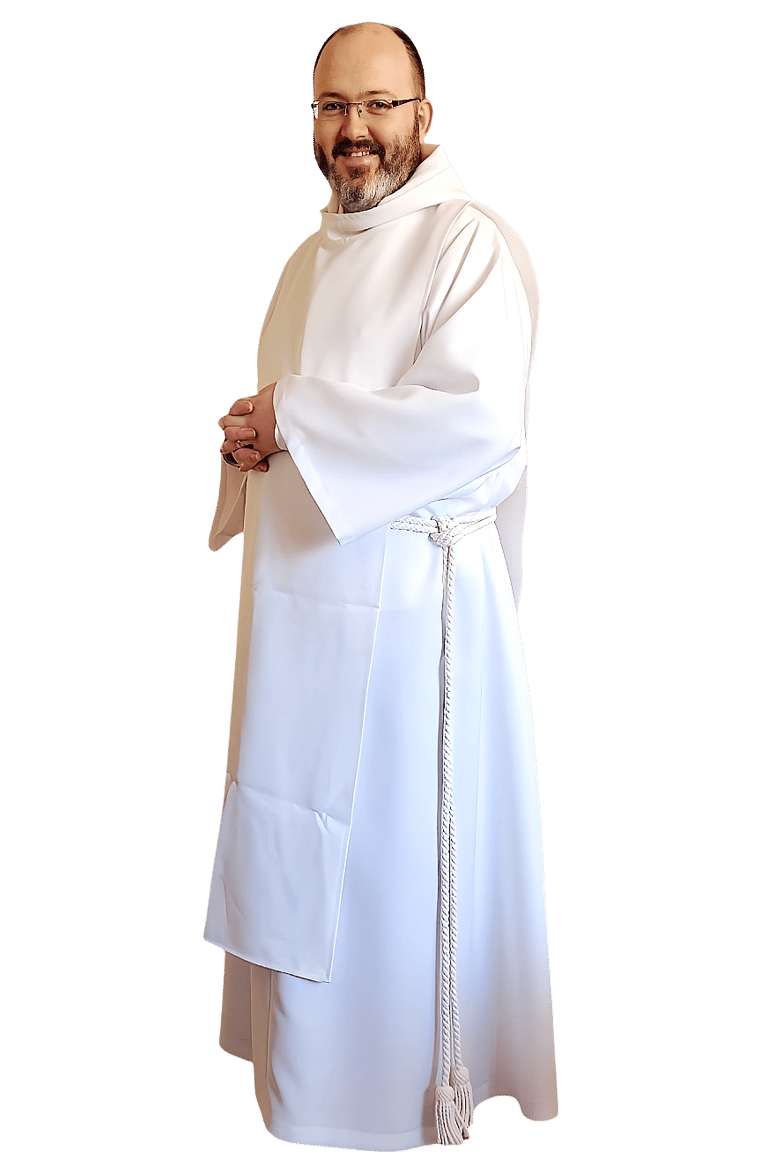
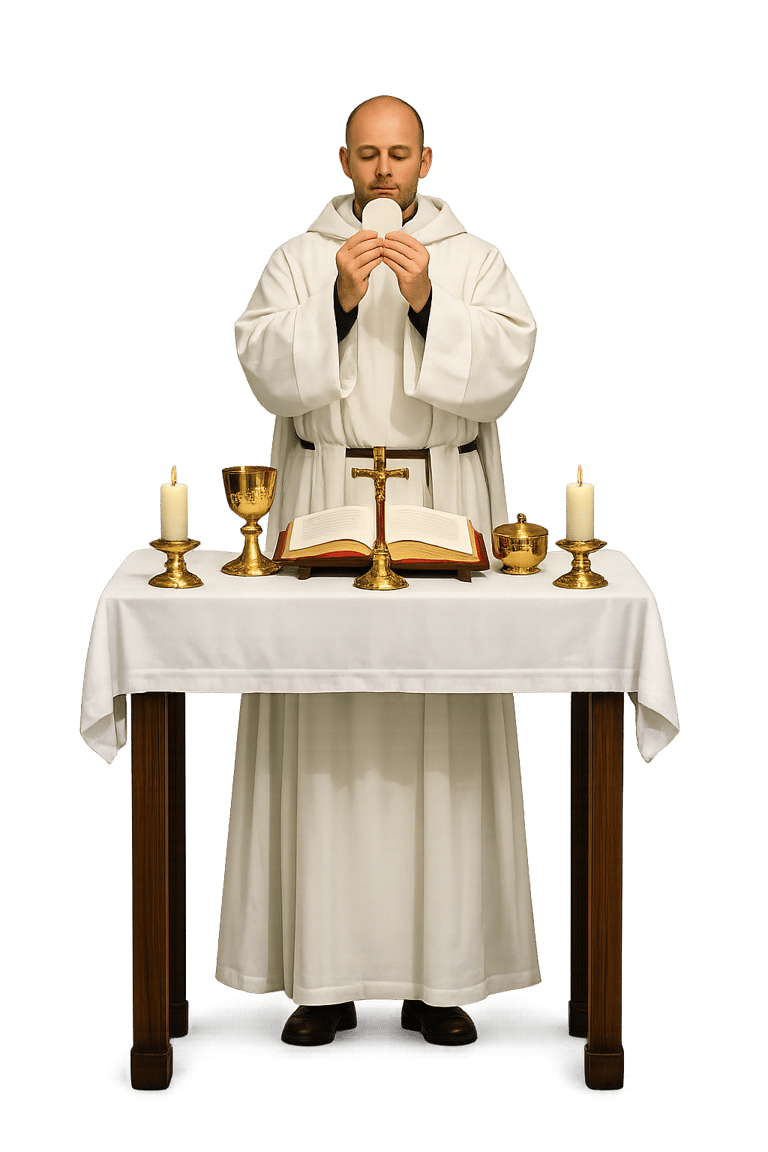
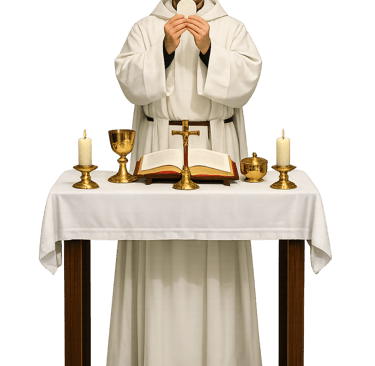
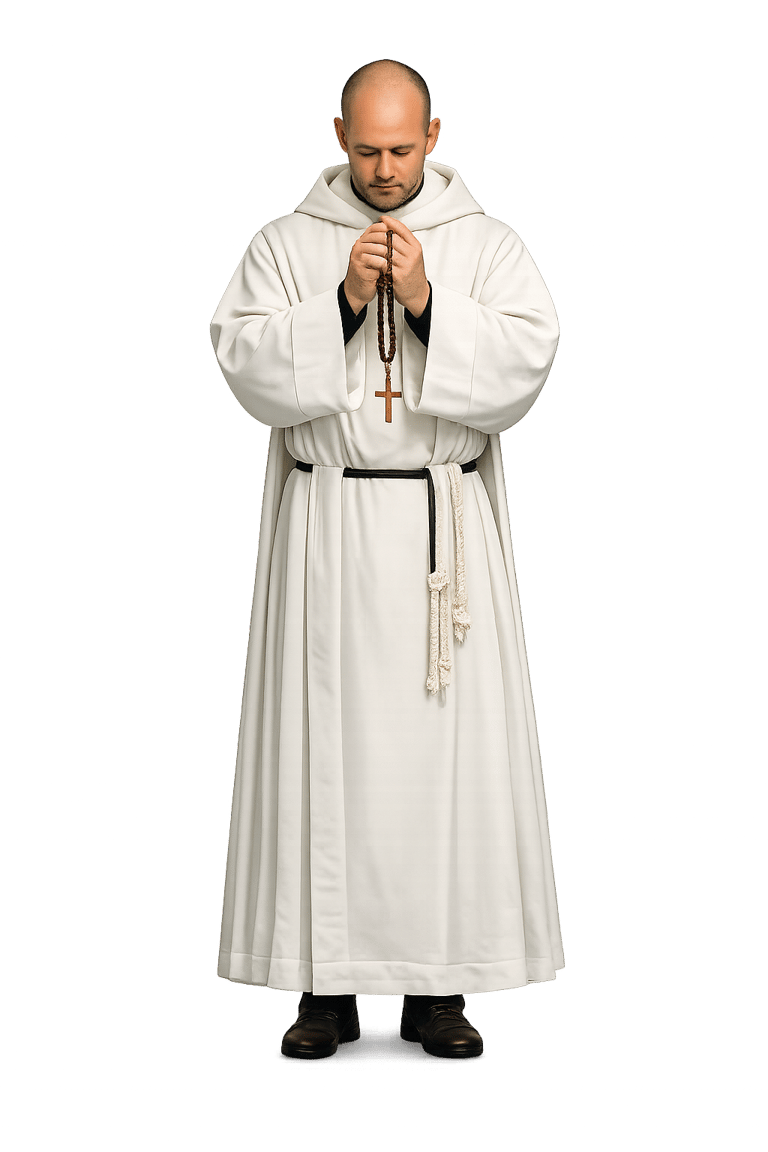
Most members do not wear a habit in daily life. The Order's character is one of hidden consecration: members look and dress like everyone else. Fully professed clerical members may wear the white habit of the Order for liturgical and solemn occasions.
This hiddenness is not a compromise -- it is, in fact, one of the most distinctive and demanding aspects of secular institute life. There is no external marker to remind you of who you are or to invite the respect of others. Your consecration is witnessed not through a distinctive garment but through the quality of your attention, your patience, your generosity, and your prayer. Saint David himself exemplified this: he lived with great austerity and simplicity, not in order to be seen to be holy, but because simplicity was the natural expression of a heart entirely given to God. The Order invites its members into the same hidden fruitfulness.
What if I start the process and realise it is not for me?
Discernment is an honest process, and it is entirely possible that you may explore the Order and conclude that God is calling you elsewhere. During the period of inquiry and the novitiate, you are free to withdraw at any time without any stigma or canonical consequence. The Order supports discernment in all its outcomes.
The Celtic tradition has always understood pilgrimage as a movement of the heart, not merely a fixed destination. Sometimes the path leads somewhere unexpected. If you discover during your time with the Order that your calling lies in a different direction -- perhaps as an oblate of a monastery, a member of a parish community, or simply as a faithful lay person without formal affiliation -- that is a genuine and valuable outcome of discernment. Nothing is wasted. The Order will continue to hold you in prayer, and you are always welcome to return if circumstances change.
How do I take the first step?
Simply get in touch. You can contact us through the enquiry form on this website, by email, or by letter. We will arrange an initial conversation, answer your questions, and, if you wish to proceed, connect you with a guide who will accompany you through the early stages of discernment.
There is no obligation involved in making an enquiry. You are not committing to anything by asking questions, and the Order does not regard curiosity as a promise. Many people spend several months simply reading, praying, and corresponding before deciding whether to enter a more formal period of inquiry. Whatever pace suits you is the right pace.
Who was Saint David, and why is the Order named after him?
Saint David (Dewi Sant in Welsh) is the patron saint of Wales, and one of the most beloved figures of the early Celtic Church. He lived in the sixth century, probably dying around the year 589, and founded a monastic community at Mynyw (now St Davids) in the far south-west of Wales. His community was renowned for its simplicity and austerity: members worked the land by hand, ate a diet of bread, vegetables, and water, and gave themselves to long hours of prayer and manual labour.
What makes Saint David particularly compelling as a patron is not only his holiness but his humanity. His most famous words, spoken to his community on the eve of his death, capture the whole spirit of his life: "Be joyful, keep the faith, and do the little things." These words are not a programme for spiritual heroism. They are an invitation to faithful, joyful, attentive presence in ordinary life. The Order of St David takes its name and its spirit from him: not as a historical monument, but as a living teacher whose wisdom speaks as freshly now as it did in sixth-century Wales.
What is the Celtic spiritual tradition?
The Celtic Christian tradition refers to the form of Christianity that flourished in Ireland, Wales, Scotland, Brittany, and beyond from roughly the fifth to the ninth century. It was a Christianity deeply rooted in creation, in community, in poetry, in pilgrimage, and in an intense awareness of the nearness of God. Celtic monks and saints understood the world as a place saturated with divine presence: what they called "thin places" -- locations, moments, and relationships where the boundary between heaven and earth becomes nearly transparent.
Celtic spirituality is characterised by a number of distinctive notes: a love of nature as the "first scripture"; a rhythmic, prayer-soaked approach to daily life; a strong tradition of spiritual friendship (the anamchara, or soul friend); an embrace of penitential pilgrimage and creative solitude; and a rich tradition of poetic prayer, most fully preserved in collections such as the Carmina Gadelica. The Order of St David draws deeply from this well, offering its members a way of prayer and life rooted in this ancient tradition whilst adapted for the realities of contemporary secular life.
What is the Rule of St David?
The Rule of St David is the guiding document of the Order. It sets out the spiritual vision, the daily commitments, the structure of formation, and the community life of its members. Like the ancient monastic rules from which it draws inspiration, it is not a legal code but a way of life: a practical wisdom document designed to help ordinary people live with greater intentionality, prayer, and love.
The Rule takes its inspiration directly from Saint David and the Celtic tradition, whilst also drawing on the broader inheritance of Western monastic spirituality, particularly the Rule of Saint Benedict. Its tone is warm, accessible, and human. It asks nothing superhuman of its members, but it does ask for consistency, honesty, and a genuine desire to grow. At its heart is the conviction that holiness is not achieved by extraordinary acts but by faithful attention to the little things of daily life, offered day by day in love.
Copies of the Rule of St David are available through the Order's publications. It is strongly recommended reading for anyone considering membership, even before making formal enquiry.
What is The Little Hours: A Celtic Prayer Book?
The Little Hours is the Order's own prayer book, produced for use by members and all who wish to pray in the Celtic tradition. It provides a gentle daily cycle of prayer based on the traditional canonical hours -- morning, midday, evening, and night -- adapted for people living in the world rather than in a monastery. The prayers draw from ancient sources, including the Carmina Gadelica (the great collection of Gaelic prayers and blessings gathered in the Scottish Highlands), as well as from Welsh and Irish Christian tradition.
The book also includes material on the Celtic saints, the caim prayer tradition, a treasury of traditional prayers, and reflections on the spirituality of thin places. It is designed to be a companion for daily life, not a liturgical text for specialists. Members of the Order use it as the basis of their daily prayer, but it is also available to any person who wishes to draw on the richness of this tradition. Whether you pray alone at a kitchen table or with others in a small community, The Little Hours is intended to accompany you.
What is the caim prayer tradition?
The caim (pronounced roughly "cyme") is a form of prayer drawn from the Celtic tradition, in which the one praying draws an invisible circle of protection around themselves, a loved one, or a situation, invoking the presence and protection of God. The word comes from the Gaelic for "to encircle." It is one of the most characteristic expressions of Celtic Christian prayer: intimate, embodied, and deeply trusting.
The caim is not a magical formula but a posture of the heart -- an act of surrendering a person or situation into the encircling love of God. The tradition speaks of Christ, the Trinity, the angels, and the saints as forming a circle around the one who prays. In the Order's prayer life, the caim is used both in formal prayer and as a spontaneous act in daily life: a quiet, internal gesture of entrusting the moment, the encounter, or the difficulty to the One who holds all things. Members are encouraged to develop their own caim prayers as part of their growing life of prayer.
What are "thin places"?
The concept of thin places is one of the most evocative gifts of the Celtic Christian imagination. A thin place is a location, a moment, or an encounter where the distance between the visible and invisible worlds seems to become almost nothing -- where heaven and earth, the human and the divine, touch one another with unusual closeness.
Thin places in the geographical sense include ancient sacred sites, wild coastlines, island monasteries, and mountain summits. But the Celtic tradition also speaks of thin places in time (the great seasons of the liturgical year, the threshold moments of dawn and dusk) and in experience (prayer, grief, great beauty, and acts of love). The Order's spirituality encourages members to develop an attentiveness to the thin places of their own lives: to notice where God seems close, to cultivate that awareness, and to return to those places and moments as wells of refreshment. One of the fruits of faithful prayer is precisely this: that the whole of ordinary life begins to become a thin place.
How does the Order differ from a Third Order or a group of oblates?
Third orders and oblate communities are wonderful expressions of lay spirituality, and the Order respects and values them greatly. However, the Order of St David is a secular institute, which represents a more formal and canonical level of commitment.
Third order members affiliate themselves with a religious family (Franciscans, Dominicans, Carmelites, for example) and follow an adapted rule suited to lay life, but do not make canonical vows or professions. Oblates similarly associate themselves with a monastic community and follow its rule in a simplified form. Members of the Order of St David, by contrast, make a genuine canonical profession of the evangelical counsels. This profession, made after a significant period of formation, constitutes a real and lasting commitment, and places the member within the Church's recognised category of consecrated life. It is a deeper and more binding commitment, though one that is offered with great care, flexibility, and pastoral support.
What happens during the novitiate?
The novitiate is the principal period of formation before profession. After an initial period of inquiry (during which you come to know the Order and the Order comes to know you), those who wish to proceed are received as novices. The novitiate ordinarily lasts between one and three years, depending on individual circumstances.
During the novitiate, you will follow the Rule of St David in its fullness for the first time, meet regularly with your spiritual director, participate in the life of the Order, undertake a programme of reading and reflection, and attend an annual retreat. The novitiate is not a test to be passed but a season of deepening: an opportunity to discover whether this particular form of consecrated life truly fits the contours of your soul. At the end of the novitiate, you and the Order's leadership discern together whether you are ready to proceed to temporary profession.
What is profession, and how does it work?
Profession is the formal act by which a member commits themselves to the evangelical counsels within the Order. There are two stages. Temporary profession is made at the end of the novitiate and is renewed annually for a period of between two and five years. It allows both the member and the Order to continue discerning the vocation in a committed but non-permanent way.
Final profession (sometimes called solemn or perpetual profession) is the lifelong commitment. It is made once the member, their spiritual director, and the Order's leadership are all confident that the vocation is clear and mature. Final profession is a solemn occasion, celebrated liturgically, and represents the full and lasting gift of the member's life to God within the Order. It is not to be hurried. The Order would far rather accompany a person through a long and careful discernment than receive an early commitment that has not had time to take root.
Do I need a spiritual director?
A spiritual director is not optional in the Order's understanding of formation. The Celtic tradition placed great importance on the anamchara -- the soul friend -- as a companion and guide on the inner journey. Saint Brigid of Kildare is said to have declared that anyone without a soul friend is like a body without a head. The Order takes this seriously.
Your spiritual director need not be a member of the Order, but should be someone experienced in the life of prayer and formation. The Order can help you identify a suitable director if you do not already have one. The relationship with your director is confidential and personal: it is not a form of reporting to the Order, but a pastoral relationship for your own benefit and growth. You will meet with your director at least monthly, and the director's counsel will play an important part in discernment throughout your time of formation.
Is there a financial cost to membership?
The Order does not charge membership fees, and no one is ever refused consideration because of financial circumstances. Members are encouraged to contribute to the life and mission of the Order according to their means, in the spirit of the evangelical counsel of poverty. This contribution is treated as a matter of personal discernment and is never a condition of membership.
There may be modest costs associated with retreats, publications, and travel to gatherings, and these vary by individual circumstance. The Order is committed to ensuring that practical financial considerations are never a barrier to someone who is genuinely called to this way of life. If you have concerns about costs at any stage, please raise them openly with your guide or with the Prior General's office.
Can someone from outside the Catholic tradition join the Order?
Yes. The Order is a Catholic institute, and membership is ordinarily open to those who are baptised and who hold to the Catholic faith in its essential content. This includes members of the Ancient Apostolic Catholic Church, other independent Catholic jurisdictions, and those in good standing in the Roman Catholic Church.
In exceptional circumstances, the Order may receive enquiries from those in other Christian traditions who feel a strong resonance with the Celtic spirituality and the spirit of Saint David. Such enquiries are always treated with respect and given careful consideration. The Order's leadership is happy to have a frank and friendly conversation with anyone who is drawn to this way of life, whatever their background, in order to discern together what form of association might be appropriate and life-giving.
What does the Order offer to its members on an ongoing basis?
Membership of the Order is not a private devotion pursued in isolation. The Order seeks to be a genuine community, even though its members may be geographically dispersed. Members receive regular communications from the Order, including a newsletter, seasonal reflections, and updates on the Order's life and work. Regional gatherings (where numbers allow) provide an opportunity for members to pray, share, and support one another in person.
Each member is accompanied by a spiritual director and has access to the Prior General's office for matters of canonical or pastoral concern. The Order's publications, including the Rule of St David and The Little Hours, are available to all members. An annual retreat, led by the Order, provides time for deeper renewal and community. Above all, members are held in the daily prayer of the Order: whatever joys and difficulties the year brings, you do not carry them alone.
I have tried to keep each answer in the same warm, measured, theologically grounded register as your originals, whilst drawing in the specific language and themes of the Rule, the prayer book, and the Order's Celtic and Davidic character. Let me know if you would like any of these expanded further, rearranged, or adapted for a particular section of the site.
I am interested but not sure I am holy enough. Is the Order for people who already have a strong prayer life?
This is perhaps the most important question on this page, and the honest answer is: no. The Order is not for people who have already arrived. It is for people who know they have not, and who are serious about the journey.
Saint David did not gather around him those who had already achieved holiness. He gathered those who were willing to seek it, day by day, in simplicity and fidelity. The Celtic tradition has always understood the spiritual life as a pilgrimage -- a movement towards God that continues until death -- rather than a status to be achieved or a qualification to be demonstrated. What the Order asks of those who enquire is not a track record of impressive prayer or conspicuous virtue. It asks for honesty, desire, and a genuine willingness to be formed.
If you find yourself drawn to a more intentional life of prayer but feel that your prayer life is inconsistent, distracted, or underdeveloped, that is not a disqualification. It is, in many cases, precisely the starting point from which formation begins. The novitiate exists because growth takes time. Your guide and your spiritual director will walk with you as you are, not as you think you ought to be. The only genuine obstacle to enquiring is a lack of desire. If the desire is there, the rest can grow.
What exactly do the evangelical counsels mean in practice for someone living an ordinary life?
The evangelical counsels -- chastity, poverty, and obedience -- have a long history in the Church, and they carry associations that can make them sound remote from ordinary life. In a secular institute, they are not remote at all. They are translated into the very texture of daily existence.
Chastity, for members of the Order, does not mean celibacy for all. It means integrity in love: the ordering of all one's relationships, affections, and desires towards God and towards the genuine good of others. For a married member, this means faithful, self-giving love within the covenant of marriage. For a single member, it means a life of loving, undivided attention to God and neighbour, free from the distortions of self-seeking or possessiveness. For all members, it means a quality of presence and care in every relationship.
Poverty does not mean destitution. It means simplicity: a deliberate loosening of the grip that possessions, security, and status can exercise over the heart. A member living the counsel of poverty will ask themselves honestly whether what they own, earn, or consume is consistent with the spirit of Saint David, who ploughed his own fields and drank water rather than wine. This does not require dramatic gestures. It requires ongoing, honest discernment about sufficiency, generosity, and detachment.
Obedience does not mean the surrender of conscience or judgment. It means a habitual disposition of humility: a willingness to listen before asserting, to serve before leading, to submit one's own preferences to the discernment of the community and the guidance of the Church. In practice, this is expressed through regular recourse to one's spiritual director, participation in the Order's common life, and fidelity to the Rule. For many people, obedience turns out to be the most challenging of the three counsels, and the most liberating.
I have never heard of the Ancient Apostolic Catholic Church. How do I know it is a legitimate expression of the Catholic faith?
This is a fair and important question, and it deserves a straightforward answer.
The Ancient Apostolic Catholic Church is an independent Catholic jurisdiction, which means it operates outside the governance structure of the Roman Catholic Church whilst maintaining the same apostolic succession, the same seven sacraments, the same creeds, and the same essential doctrines of the historic Catholic faith. Its bishops hold valid orders transmitted through lines of apostolic succession recognised by canon historians and ecclesiologists. Independent Catholic Christianity of this kind has a long and documented history, particularly following the Old Catholic schism of the nineteenth century and the various apostolic succession lines that have descended from it.
The Order of St David is canonically established within the Ancient Apostolic Catholic Church, which provides it with genuine and recognised canonical standing. However, the Order is structured to manage its own affairs with a high degree of internal independence. Its governance is exercised through the General Chapter -- the assembly of professed members -- and through the Prior General, who holds executive authority over the Order's day-to-day life, formation, and mission. The AACC's role is not to direct or administer the Order, but to provide the canonical framework within which the Order legitimately exists and operates.
There are a small number of areas where the Order looks to the AACC for formal involvement. These include the canonical establishment of new regional houses or formal structures, the solemn reception of final professions (which are witnessed by a bishop of the Church), the approval of any significant revision to the Rule or Constitutions, and matters of canonical appeal that cannot be resolved internally. In all other respects -- formation, community life, prayer, publications, retreats, and the day-to-day accompaniment of members -- the Order governs itself.
If you come from a Roman Catholic background, or from another Christian tradition, and you have questions about how this relates to your own ecclesial situation, the Order's leadership is very willing to speak with you openly and at whatever length is helpful.
I feel drawn to contemplative life but know I am not called to a monastery. Could the Order be right for me?
Quite possibly. The tension you are describing -- between a genuine longing for depth, silence, and God, and a clear sense that your life belongs in the world -- is not a confusion to be resolved. It may itself be a vocation.
The Church has always recognised that contemplative desire does not always lead to the cloister. Some people are called to carry the contemplative heart into the midst of ordinary life: into offices and families, streets and schools, conversations and commitments. This is precisely the charism of a secular institute. Members of the Order are not monastics manqués. They are people who have discerned that their particular form of seeking God is one of hidden presence in the world, sustained by a serious and structured interior life.
The Order's daily prayer, rooted in the Little Hours and the Celtic tradition of rhythmic, creation-soaked attentiveness, is designed to support exactly this kind of contemplative engagement with ordinary life. The thin places of Celtic spirituality are not only to be found in remote island hermitages: they open up in the commute, the kitchen, the bedside of a sick friend, the moment of unexpected beauty in an urban street. Learning to recognise and inhabit those moments is, in many ways, what the Order's formation is for.
If you feel this resonance, it is worth taking seriously. A period of inquiry will help you discern whether the Order is the particular form in which God is inviting you to live it out.
How does the Order's Celtic spirituality differ from generic Christian spirituality? What makes it distinctive?
Celtic Christianity is not simply Christianity with a preference for green landscapes and knotwork borders. It is a particular way of understanding the relationship between God, creation, humanity, and time -- one that has its own distinctive emphases and a richness that rewards serious engagement.
Several notes distinguish it from more generic expressions of Christian spirituality. First, there is a profound theology of creation. Celtic Christians understood the natural world not as a backdrop to spiritual life but as a primary mode of divine revelation, sometimes called the "first scripture." To pray outdoors, to notice the quality of light, to attend to the turning of the seasons, was not a romantic indulgence but a theological act. God speaks through the storm and the river as surely as through any text.
Second, there is the centrality of the anamchara, the soul friend. Celtic spirituality is not individualistic. It insists that the inner journey must be accompanied by another human being who knows you, loves you, and tells you the truth. The Order carries this forward through its emphasis on the spiritual director as an irreplaceable companion in formation.
Third, there is the tradition of the caim: the encircling prayer, the sense that divine protection and presence can be invoked around the particular, the vulnerable, and the beloved. This gives Celtic prayer an intimacy and a concreteness that can feel very immediate.
Fourth, there is the concept of thin places: those locations, moments, and encounters where the membrane between heaven and earth becomes nearly transparent. Celtic spirituality trains a particular kind of attentiveness, a readiness to notice where God draws near.
Finally, there is the witness of the saints themselves -- David, Brigid, Columba, Brendan, Non, and many others -- whose lives, recorded in tradition and poetry, offer vivid and particular models of the holy life. The Order draws deeply from this well, not as an exercise in nostalgia, but because this tradition speaks with remarkable freshness to the hungers of contemporary life.
Can the Order's prayer life work for someone who travels frequently, works irregular hours, or has significant caring responsibilities?
The short answer is yes, and the Rule of St David has been written with precisely this question in mind.
The Order does not ask its members to follow a timetable suited to a monk in a settled cloister. It asks for fidelity to a pattern of prayer that is flexible enough to be carried through the disruptions and irregularities of real life. The daily commitment of an hour may be distributed across the day in whatever way circumstances allow. The Little Hours can be prayed in a hotel room, on a train, in a few quiet minutes between caring tasks, or silently in the heart during a moment that cannot be set aside. What matters is not the perfect observance of a fixed schedule but the honest intention to return to God throughout the day, whatever the day looks like.
Members who travel frequently often find that the rhythm of the Little Hours becomes an anchor rather than an additional demand: a thread of recollection that holds the day together when everything else is in flux. Members with significant caring responsibilities -- for children, elderly parents, or those with disabilities -- are accompanied by their spiritual directors in finding a shape of prayer that is sustainable and honest, rather than aspirational and guilt-inducing.
The Order's approach to all of this is pastoral and realistic. No member will be held to an impossible standard. What the Rule asks for is not perfection but perseverance: the willingness to begin again, each day, with whatever is possible.
How large is the Order, and where are its members based?
The Order of St David is a young institute, and it is worth being honest about that. It does not have the centuries of history or the large membership of some older religious families. It is a living community in the early stages of its growth, and those who join now do so as pioneers as much as inheritors.
Members are drawn from different countries and different backgrounds, united by a shared vocation to the Celtic spiritual tradition and to the spirit of Saint David. Because secular institute members live in their own homes and pursue their ordinary lives, the Order does not have a single geographical centre in the way that a monastery does. Its community life is sustained through correspondence, digital communication, regional gatherings where members are close enough to gather, and the annual retreat.
There is something genuinely beautiful about belonging to a community that is small and still forming. The early members of any religious family carry a particular responsibility and a particular grace: they help to shape the character of something that will, God willing, outlast them. If you are drawn to the Order, you are not joining an institution in the sense of a large and settled organisation. You are joining a living community, and your presence will matter to its growth.
What happens at an annual retreat, and what would a typical gathering look like?
The annual retreat is the single most important gathering in the Order's common life. It ordinarily lasts at least three days, and provides members with dedicated time for silence, prayer, reflection, and renewal of their commitment. The retreat follows a structured but unhurried pattern: there will be times of communal prayer using the Little Hours, an opportunity for the sacraments, input from a retreat conductor on a theme drawn from the Order's life and tradition, periods of unstructured silence and personal prayer, and time for members to be together informally.
The atmosphere of the retreat is neither rigidly liturgical nor casually social. It sits in that particular space that the Celtic tradition inhabits well: serious without being solemn, warm without being superficial. Members often describe the annual retreat as the moment in the year when the things they have been living and praying privately come into focus and find their communal expression.
Regional gatherings, where they take place, are lighter in structure: perhaps a shared morning prayer, a period of reflection or discussion on an aspect of the Rule or the Order's tradition, time for individual conversations, and a shared meal. They are as much about relationship and mutual support as they are about formal programme. The Order understands that the anamchara tradition does not belong only to the one-to-one relationship with a spiritual director: it extends to the whole community of those who share the journey.
I am already involved in my parish or another ministry. Would joining the Order create a conflict of loyalty or add too much to my commitments?
The Order does not seek to pull its members away from the ecclesial communities and ministries in which they already serve. It seeks, rather, to deepen and sustain the interior life from which all genuine service flows.
Many members of secular institutes find that their existing ministry is actually enriched by membership of the Order. The structured prayer life, the regular meeting with a spiritual director, and the sense of belonging to a community with a clear spiritual vision all contribute to what might be called the quality of interior resource available for service. A person who is praying well is generally more patient, more present, and more genuinely useful than a person who is serving on willpower alone.
That said, the Order takes the question of overcommitment seriously. One of the things your spiritual director will help you discern is whether adding the Order's commitments to an already full life is wise and sustainable. The counsel of poverty includes a poverty of activity: a willingness to do fewer things with greater depth, rather than accumulating engagements out of restlessness or a need to be needed. If joining the Order would require you to relinquish something else, that relinquishment might itself be part of what God is asking.
The Order is not in competition with your parish, your diocese, or any other form of ministry you are engaged in. It is, if anything, an interior foundation for all of it.
I have been through a difficult period: bereavement, illness, a crisis of faith. Is this the right time to consider joining, or should I wait until life is more settled?
There is no single answer to this, because it depends greatly on the nature of your experience and where you currently are within it. But it is worth saying clearly: difficulty, grief, and even doubt are not disqualifications for the spiritual life. In many cases, they are its very doorway.
The Celtic tradition understands suffering as one of the great thin places: a moment when the ordinary defences of the self are lowered and God can draw very close. Many of the saints whose lives inspire the Order -- David himself, Brigid, Columba -- knew loss, displacement, and inner struggle. Their holiness was not formed in spite of these things but through them. The Order does not ask its members to arrive healed. It asks them to be honest.
If you are in the acute phase of a bereavement, a serious illness, or a profound crisis of faith, it may well be that the most important thing is simply to receive care and support before adding any new commitment. The Order would not encourage anyone to seek formal association at a moment when they are barely keeping their head above water. But if you are moving through difficulty rather than being submerged by it, if the experience has sharpened rather than extinguished your desire for God, then enquiring need not wait for a season of complete calm. Life rarely offers such seasons.
The most honest course is to speak to someone. An initial conversation with a member of the Order's leadership, or simply with a trusted priest or spiritual guide, will help you discern whether this is a moment for enquiry or a moment for rest. Both are good. Neither is failure.
These answers follow the same structure and tone as the rest of the FAQ: a direct response to the question, followed by deeper pastoral or theological development, and closing with a note that is human, honest, and inviting. Let me know if you would like any of them adjusted in emphasis or length.
Take the First Step
Every journey begins with a single step. If you feel drawn to learn more about the Order of St David, we warmly invite you to get in touch. There is no obligation and no pressure. We are simply here to listen, to share, and to help you discern whether God might be calling you to walk this path.
Contact us today to begin a conversation about your vocation. We would be delighted to hear from you.
Order of St David © 2026 All Rights Reserved.